
WHAT IS AN INFORMATION SYSTEM?
Topics Covered:
- Computer Literacy vs. Information Literacy
- Introduction to Information Systems
- Strategic Use of Information Systems
1.1 Introduction
In today’s organizations, information is one of the most valuable assets a business owns. Every decision—from hiring and budgeting to marketing and product development—depends on timely, accurate, and relevant information. The systems that collect, process, store, and distribute this information are called Information Systems (IS). An information system does more than manage technology. It helps organizations work smarter, make better decisions, and gain a competitive advantage. This chapter introduces the core concepts of information systems, explores their role in business, and explains how technology supports management and strategy.
1.2 Computer Literacy vs. Information Literacy
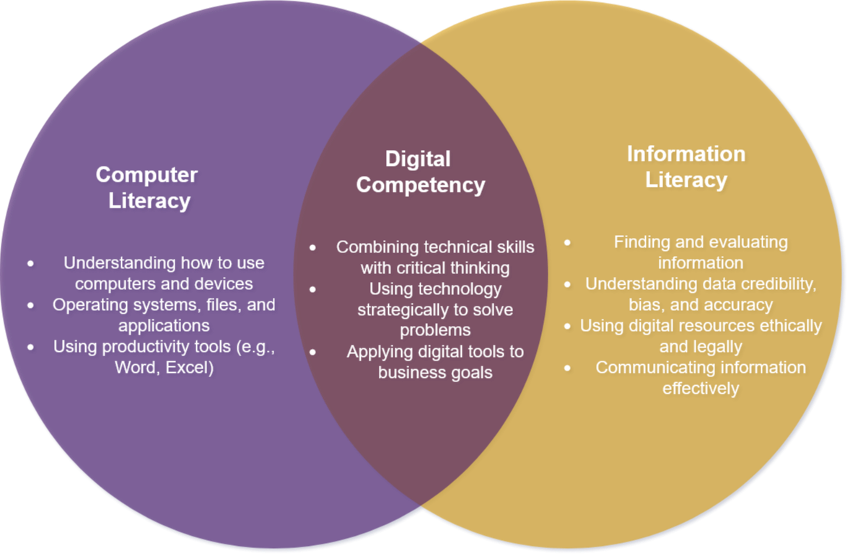
While computer literacy focuses on understanding how to use computers and software effectively, information literacy is about understanding how to find, evaluate, and use information to solve problems. Both are essential in today’s workplace.
Computer Literacy: The ability to use hardware and software tools, such as word processors, spreadsheets, databases, and communication tools. It emphasizes technical proficiency. Computer Literacy is, in essence, how to use technology efficiently.
Information Literacy: The ability to understand what data means, how to analyze it, and how to use it in decision-making. Information-literate individuals can critically evaluate sources of data and apply insights ethically and strategically.
Modern organizations need employees who are both computer-literate and information-literate. For example, the MOS Excel certification that you earned in CIS 148 is a mark of practical computer literacy. That certification tells a potential employer that you have demonstrated a high level of proficiency using spreadsheet software. The Python programming that we’ll do in this course is also a computer literacy skill. When you learn to apply these skills to make business decisions in your Data Analytics and Finance courses, you’re practicing information literacy. Computer literacy skills enable employees to interact with systems effectively, while information literacy allows them to interpret data for better business outcomes.
Figure 1.1 – Computer Literacy and Information Literacy: Building Digital Competency
1.3 Management Information Systems (MIS)
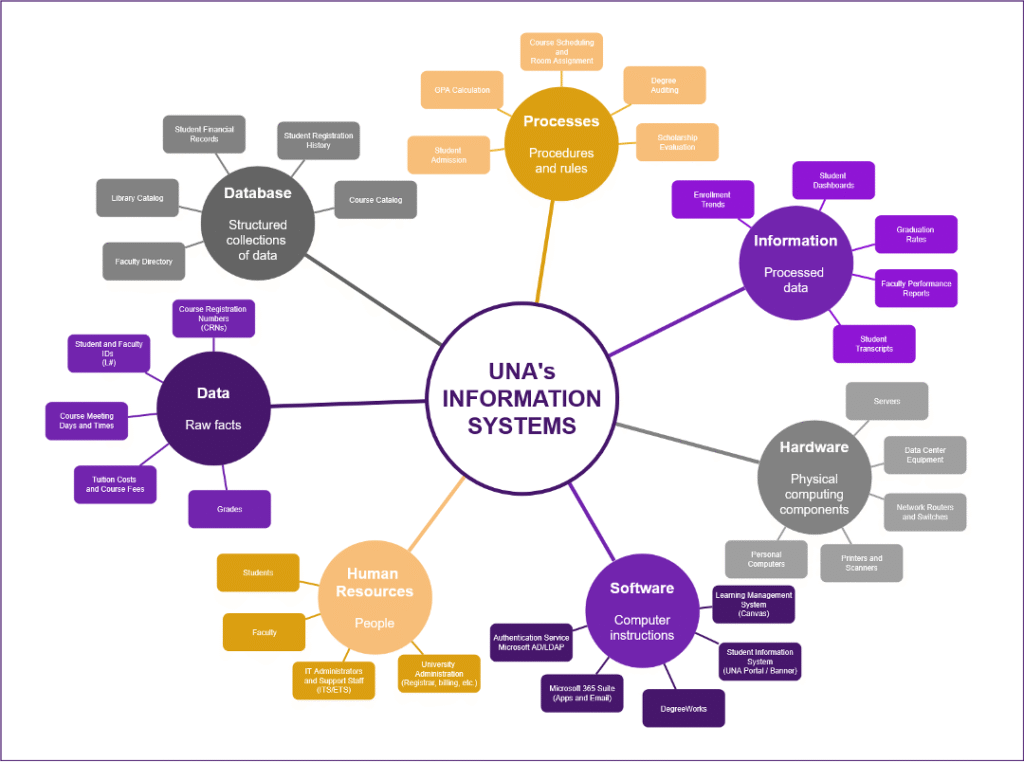
A Management Information System (MIS) is a coordinated set of components that collect, process, store, and distribute information to support decision-making, coordination, and control in an organization. An organization’s MIS is made up of all the hardware, software, data, processes, and people in the organization. MIS integrates technology with people and processes to ensure that managers and employees have the information they need to perform their roles efficiently.
Figure 1.2 – UNA’s Management Information Systems
Major Components of an Information System:
- Data: Raw facts that describe characteristics of events or objects, such as sales transactions, customer names, or product prices.
- Database: A structured collection of related data organized for quick retrieval and analysis, often maintained by database management software.
- Processes: The procedures and rules that transform raw data into meaningful information, including business rules and workflow logic.
- Information: Processed data that provides context and meaning, enabling decision-making and problem-solving.
- Hardware: The physical components of an information system such as computers, servers, input/output devices, and networking equipment.
- Software: The set of instructions that tells hardware what to do, including operating systems, applications, and utilities.
- Human Resources: The people who design, manage, and use the system, from IT professionals to end users across all departments.
1.4 A Brief History of Information Systems in Business
Information systems have evolved alongside computing technology. Early systems were designed for recordkeeping and automation of repetitive tasks, while modern systems leverage real-time data and artificial intelligence for strategic decision-making.
1.4.1 Transaction-Processing Systems (TPS)
The first major use of computers in business was for transaction processing—recording routine activities such as payroll, sales, and inventory management. Transaction-Processing Systems (TPS) are essential for ensuring accuracy and consistency in large volumes of data.
Examples include point-of-sale systems in retail stores, ATM networks in banking, and airline reservation systems. These systems focus on efficiency and reliability, forming the foundation of most business data operations.
1.4.2 Modern Applications of Information Systems
As technology has advanced, information systems now integrate analytics, cloud computing, and artificial intelligence. Modern systems support collaboration, customer engagement, and real-time decision-making.
Information systems today are deeply embedded in every business function, enabling departments to operate more efficiently and collaboratively.
Marketing: IS helps marketers analyze customer behavior, segment audiences, and personalize campaigns. Tools like Google Analytics and marketing automation platforms such as Salesforce provide insights into campaign performance and customer engagement.
Finance: Financial systems manage budgeting, forecasting, and reporting. They ensure compliance, track expenditures, and support strategic planning. Examples include QuickBooks and SAP Financials.
Human Resources (HR): HR systems streamline recruitment, onboarding, payroll, and performance management. Platforms like Workday and BambooHR help HR professionals manage employee data and improve workforce planning.
Operations: IS supports supply chain management, inventory control, and production scheduling. Systems like Oracle SCM and manufacturing execution systems (MES) optimize resource use and reduce waste.
1.4.3 Other Categories of Information Systems
Beyond MIS and TPS, organizations use a variety of specialized information systems to support decision-making, strategic planning, and operational efficiency. These systems differ in scope, purpose, and the level of decision they support.
Decision Support Systems (DSS)
DSS help managers make semi-structured or unstructured decisions by analyzing large volumes of data and presenting actionable insights. They often include modeling tools, simulations, and “what-if” analysis. Example: A retail company using DSS to forecast sales based on seasonal trends.
Executive Information Systems (EIS)
EIS are tailored for senior executives, providing high-level summaries and dashboards of key performance indicators (KPIs). These systems support strategic decision-making and often integrate data from multiple sources. Example: A CEO using an EIS to monitor company-wide financial performance.
Enterprise Resource Planning (ERP)
ERP systems integrate core business processes across departments into a unified platform. They improve data consistency, reduce duplication, and enhance collaboration. Example: SAP ERP used to manage finance, HR, and supply chain in a manufacturing firm.
Customer Relationship Management (CRM)
CRM systems manage customer interactions, sales, and support. They help businesses understand customer needs, personalize communication, and improve retention. Example: Salesforce used to track customer engagement and automate marketing campaigns.
Supply Chain Management (SCM)
SCM systems optimize the flow of goods, information, and finances across the supply chain. They improve inventory control, supplier coordination, and logistics. Example: Oracle SCM used to manage procurement and distribution in a global retail chain.
Modern organizations often use ERP systems integrated with additional systems such as CRM and SCM to track core business processes across departments, which helps organizations support both operational and strategic goals. These cross-functional systems break down information barriers between departments, enabling real-time data sharing and strategic alignment across the organization.
Examples include Amazon’s recommendation algorithms, enterprise resource planning (ERP) systems for manufacturers, and cloud-based productivity platforms like Microsoft 365.
Table 1.1 – A Brief History of Information Systems
| Era | Time Period | System Type / Development | Focus | Key Technologies and Innovations |
| Early Eras | 1950s | Transaction Processing Systems (TPS) | Electronic data processing for repetitive transactions such as sales and inventory. | Early computers and punch-card systems. IBM introduced the first commercial hard disk (1956), enabling digital record-keeping to replace physical files. |
| 1960s–1970s | Management Information Systems (MIS) | Automating business processes and generating standardized reports for mid-level management. | Centralized mainframes (e.g., IBM 360); hierarchical and network databases; Material Requirements Planning (MRP) systems for production planning. | |
| 1970s–1980s | Decision Support Systems (DSS) | Providing interactive tools for managers to analyze business data and make informed decisions. | Minicomputers and early personal computers (PCs); spreadsheet software like VisiCalc; introduction of relational databases. | |
| Era of Integration and Decentralization | 1980s–1990s | Decentralization and Executive Information Systems (EIS) | Department-level computing led to specialized systems and data silos. EIS provided key data to executives for strategic decisions. | Widespread PC adoption; client–server networking; emergence of the Chief Information Officer (CIO) role to manage decentralized systems. |
| 1990s | Enterprise Resource Planning (ERP) | Integration of separate business processes (finance, HR, logistics) into unified enterprise systems. | Relational databases integrated across functions; growth of the internet and corporate intranets enabling system connectivity. | |
| The Internet and Mobile Era | 2000s | E-Business and E-Commerce | Expansion of business operations into global, internet-based marketplaces and supply chains. | Internet commercialization; e-commerce platforms; development of Wide Area Networks (WANs). |
| 2010s | Cloud Computing and Business Intelligence (BI) | Transition to cloud-based systems accessible from anywhere; rise of self-service analytics for business users. | Cloud computing infrastructure; mobile integration; dashboards and visualization tools for BI. | |
| 2020s | AI, Big Data, and Ubiquitous Computing | Integration of artificial intelligence and machine learning into business systems for predictive analysis and automation. | AI-driven tools; Internet of Things (IoT); conversational AI interfaces; advanced analytics across devices and platforms. |
1.5 Using Management Information Systems
1.5.1 Importance and Purpose
The main goal of an MIS is to provide managers and employees with accurate, timely, and relevant information for decision-making. Business managers have questions about all aspects of their business operations, and the information system is designed to help convert raw business data into useful answers to these questions (information). An effective MIS improves productivity, supports planning, enhances communication, and helps organizations anticipate change.
1.5.2 Advantages of MIS
- Improved efficiency through automation and streamlined workflows.
- Better decision-making through real-time access to data and analysis.
- Enhanced collaboration by connecting departments and teams.
- Cost savings through reduced redundancy and improved resource use.
- Greater data accuracy and consistency, reducing human error.
1.5.3 Limitations and Challenges of MIS
- High implementation and maintenance costs requiring significant initial investment and ongoing technical support.
- Data quality issues following the principle of “garbage in, garbage out”—poor input data leads to unreliable information and flawed decisions.
- System complexity that can overwhelm users and require extensive training, reducing adoption and effectiveness.
- Information overload where too much data can paralyze decision-making rather than improve it.
- Security vulnerabilities exposing organizations to data breaches, cyberattacks, and unauthorized access.
- Dependence on technology creating operational risk when systems fail or experience downtime.
1.5.3 Porter’s Five Forces and Strategic Use of Information Systems
Michael Porter’s Five Forces Model is one of the most widely used frameworks for analyzing the competitive environment of an industry. First proposed in a 1979 article in Harvard Business Review, it identifies five fundamental forces that shape competition and profitability. Understanding these forces helps managers determine how to position their organization strategically and how to use information systems (IS) to gain or sustain a competitive advantage.
Modern businesses rely on IS not just for operational efficiency but as a strategic tool — enabling faster decision-making, improved customer relationships, innovative product design, and data-driven competitive intelligence.
| Porter’s Competitive Force | Information Systems Application |
| Rivalry Among Existing Competitors | Companies use IS to differentiate products, enhance customer loyalty, and reduce operational costs. |
| Threat of New Entrants | IS can raise entry barriers by establishing strong digital infrastructures or proprietary platforms. |
| Threat of Substitute Products or Services | Data-driven innovation helps companies create unique offerings that are difficult to replace. |
| Bargaining Power of Suppliers | Information systems improve supply chain transparency, allowing businesses to compare vendors and manage costs. |
| Bargaining Power of Customers | CRM systems and personalized marketing reduce buyer power by improving customer satisfaction and engagement. |
Porter’s model highlights that technology alone doesn’t create competitive advantage. Rather, it’s how organizations strategically apply information systems that determines their success. By aligning the information system with business objectives, companies can anticipate market changes, enhance collaboration across the value chain, and strengthen their overall market position. When building an effective information system, the strategic goals of the organization must be considered at every step of the process. Every business organization has different strategic needs, which is why there’s no one-size-fits-all information system solution.
Technology has evolved significantly since Porter’s original work, but the fundamental competitive forces have remained largely the same. In today’s digital economy, data analytics, AI, and cloud-based systems have become essential tools for navigating these competitive forces. When strategically applied, these technologies enable organizations to process the vast amounts of available data into actionable information, supporting more informed and more effective decision-making. See Case Study 1.1 below to see how Amazon leverages their considerable IS to support their operational strategy.
Case Study 1.1 – How Amazon Uses Information Systems to Support Business Strategy
To scale globally and keep costs low, Amazon needed massive computing power, real-time data processing, and an ultra-efficient supply chain. In practice this meant building custom IT systems: its own e‑commerce platform, proprietary logistics software, and a cloud infrastructure that could handle huge traffic spikes and data loads.
Amazon developed AWS (Amazon Web Services) internally to support its retail site and then commercialized it. AWS provides virtually unlimited compute and storage for Amazon’s storefront, data analytics, and fulfillment systems, ensuring reliable global service. For example, Amazon’s robotics and AI systems use AWS to store and process sensor and vision data in real time. This integrated cloud backbone directly serves Amazon’s strategy by enabling rapid feature rollout (e.g. 1‑Click ordering, same-day delivery) while keeping IT costs low.
Amazon’s recommendation engine – famously based on item-to-item collaborative filtering – uses purchase history to suggest products. This data-driven engine drives a huge portion of sales: roughly 35% of Amazon’s revenue comes from its recommender system. The system is tightly aligned with Amazon’s strategy to “invent on behalf of customers”: by automatically cross-selling relevant products, it increases average order value without raising prices. Amazon also uses advanced data analytics for pricing, search ranking and forecasting. For instance, on Cyber Monday 2023, Amazon’s AI predicted demand for 400 million products and routed inventory accordingly. These ML/forecasting systems helped Amazon save roughly $1.6 billion in 2020 on logistics and cut 1 million tons of CO₂ – a direct payoff of aligning IT with the company’s cost-leadership strategy.
Amazon’s strategy demands extremely fast delivery, which its IT empowers through robotics and optimization. Since acquiring Kiva (now Amazon Robotics) in 2012, Amazon has deployed over 750,000 robots in its warehouses. Integrated systems like the Sequoia robot/AI platform identify and store inventory up to 75% faster, and Amazon expects about 25% more productivity in next-gen centers due to these technologies. Another AI tool, the Packaging Decision Engine, optimizes packaging sizes to reduce waste. Every step, from inventory planning (sophisticated planning ensures products are near customers) to last‑mile routing (using ML to dispatch vans and drivers), is supported by dedicated IT. Together, these systems align with Amazon’s operational excellence goal: they greatly increase throughput (handling 60–110k packages/day per station during peaks) and cut human effort (15–25% labor savings) while speeding orders to customers.
Video 1.2 – Information Systems in Action: Amazon’s Robotic Fulfillment Centers
Case Reflection Questions:
- How does Amazon’s use of AWS demonstrate the role of information systems in achieving a competitive advantage?
- Could Amazon’s success with data analytics and AI be replicated by competitors, or is there something unique about its implementation?
1.7 Summary and Review
Information systems form the backbone of modern organizations. They connect people, processes, and technology to support operations and strategic decisions. Understanding their components and uses prepares students to analyze how businesses achieve competitive advantage through effective use of information.
However, as we explored in section 1.5.3, information systems are not without challenges. Implementation costs, data quality issues, security vulnerabilities, and resistance to change are real obstacles organizations must overcome. Successful business professionals understand both the capabilities and limitations of information systems, allowing them to make informed decisions about when and how to leverage technology effectively.
Looking Ahead: Course Overview
This textbook is organized into two major parts that together provide a comprehensive foundation for understanding and building modern business information systems.
Part I: Information Systems Fundamentals (Chapters IS-1 through IS-9) explores the theoretical and practical aspects of information systems in business:
- Chapter IS-2 examines computer hardware and software components, explaining how physical computing resources support business operations across PCs, mobile devices, servers, and embedded systems.
- Chapter IS-3 focuses on data—where it comes from, how it’s stored and organized, and how businesses transform raw data into actionable intelligence through decision support systems, big data analytics, and visualization tools.
- Chapter IS-4 addresses the critical legal and ethical dimensions of information systems, including privacy laws, intellectual property rights, and organizational responsibilities in an increasingly data-driven world.
- Chapter IS-5 covers information security and risk management, introducing the threats facing modern organizations and the technologies, policies, and strategies used to protect valuable information assets.
- Chapter IS-6 explores data communications and the Internet, explaining networking fundamentals and how technologies like intranets, extranets, and cloud computing enable modern business operations.
- Chapter IS-7 introduces systems analysis and design methodologies and examines how Enterprise Resource Planning (ERP) systems integrate business processes across departments.
- Chapter IS-8 looks at intelligent and emerging technologies, defining artificial intelligence and its business applications, while also exploring IoT, robotics, and other innovations reshaping organizational operations.
- Chapter IS-9 establishes foundational knowledge of file systems and command-line tools, teaching students to navigate and manage the computing environment where programs operate.
Part II: Programming Fundamentals has 10 chapters that provide hands-on experience building the technical skills needed to create business applications:
- Chapters CODE-1 through CODE-4 introduce core programming concepts including algorithms, flowcharts, variables, and data types—the building blocks of any software application.
- Chapters CODE-5 through CODE-7 develop practical programming skills through output formatting, selection structures (if/else logic), and repetition (loops), enabling students to write programs that make decisions and process data efficiently.
- Chapters CODE-9, CODE-10, and CODE-15 culminate in working with complex data structures (lists and dictionaries) and real-world data files, incorporating data visualization libraries to transform business data into meaningful insights.
Throughout both parts of this course, you’ll see how information systems theory connects to programming practice. The systems you study in the first half—transaction processing systems, decision support systems, ERP platforms—are all built using the programming concepts you’ll learn in the second half. By understanding both perspectives, you’ll be better equipped to evaluate information systems critically, communicate effectively with IT professionals, and even build your own tools to solve business problems.
Key Takeaways:
- Information systems combine data, hardware, software, processes, and people.
- Management Information Systems (MIS) provide structure for decision-making and control.
- Information systems face real challenges including implementation costs, data quality issues, and security vulnerabilities.
- Computer literacy focuses on technology skills, while information literacy emphasizes critical thinking and data evaluation.
- Strategic use of IS can strengthen a company’s position within its industry using frameworks like Porter’s Five Forces.
- Programming skills enhance your ability to understand, evaluate, and customize information systems to meet business needs.
Review Questions
- True or False? Information literacy involves not just using technology, but also understanding how to locate, evaluate, and use information effectively.
- Which of these best describes the relationship between computer literacy and information literacy? (a0 Computer literacy is broader than information literacy. (b) Information literacy is a component of computer literacy. (c) Computer literacy emphasizes technical proficiency, while information literacy emphasizes critical thinking about information. (d) They are identical in meaning.
- Which of these is a major component of an information system? (a) Data (b) Water supply (c) Physical classroom (d) Employee uniforms
- True or False? The primary goal of a Management Information System (MIS) is to deliver timely, accurate, and relevant information to decision-makers in an organization.
- True or False? In Michael Porter’s Five Forces model, the “threat of substitutes” refers to how easily customers can switch to competing products or services from another industry.
Projects
1.1 Information Systems Analysis. Analyze the information systems in use at UNA. Identify and describe at least three different information systems currently in use. For each system:
* Classify it by type (TPS, MIS, DSS, ERP, CRM, etc.)
* Identify the major components (data, hardware, software, people, processes)
* Explain its primary purpose and how it supports business operations
* Discuss one challenge or limitation the University might face with this system
1.2 Computer Literacy vs. Information Literacy. Based on your own experiences and career goals:
* Assess your current level of computer literacy (What software and hardware are you proficient with?)
* Assess your current level of information literacy (How do you find, evaluate, and use information?)
* Identify three specific skills in each area you need to develop for your intended career
* Create an action plan for developing these skills during your time at UNA